When a joint sitting of Parliament can be called
प्रकाशित
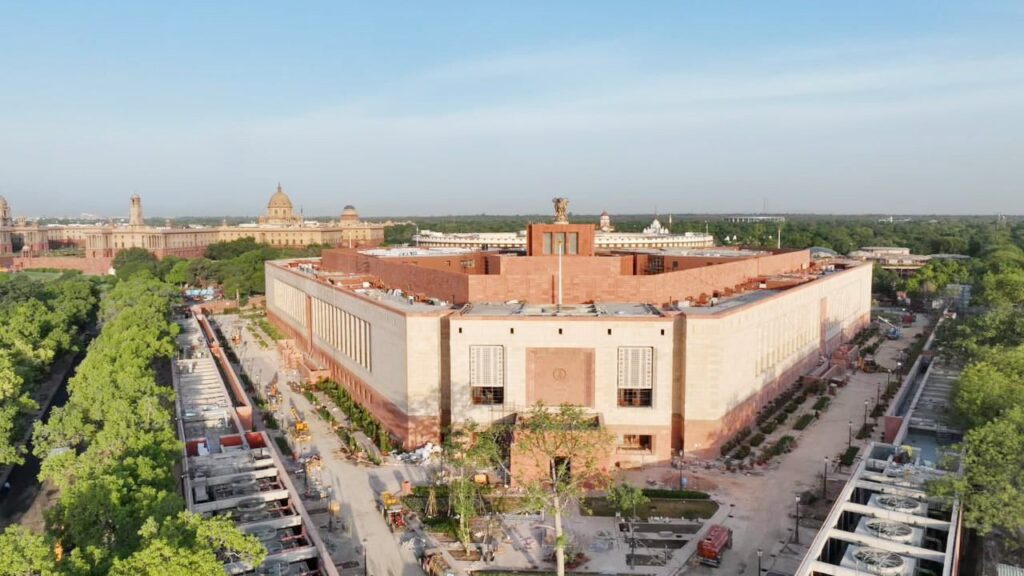
A joint sitting of Parliament is called when the Lok Sabha and the Rajya Sabha deadlock on an ordinary bill. Article 108 gives the President this power. Only three bills have ever been passed at such a sitting.
| Year | Bill |
|---|---|
| 1961 | Dowry Prohibition Bill |
| 1978 | Banking Service Commission (Repeal) Bill |
| 2002 | Prevention of Terrorism Bill (POTA) |
Table: UP Election News. Basis: parliamentary records, via Wikipedia.
When it can be called
- A bill passed by one House is rejected by the other
- The Houses disagree on amendments to the bill
- More than six months pass after the other House receives the bill without it being passed
In these cases the President notifies the Houses of the intention to summon them to a joint sitting.
How the sitting runs
Under Article 118(4) the Speaker presides, or in the Speaker’s absence the Deputy Speaker, and then the Deputy Chairman of the Rajya Sabha. A bill passes by a majority of the total members of both Houses present and voting. The Lok Sabha’s larger numbers give it the edge.
Where it does not apply
There is no joint sitting on a money bill, where the Lok Sabha has the final word. Nor does it apply to a constitutional amendment, which each House must pass separately by special majority. A joint sitting can still be held if the Lok Sabha is dissolved after the President’s notification (Article 108(5)).
Key points
- A joint sitting of Parliament is called when the Lok Sabha and the Rajya Sabha deadlock on an ordinary bill.
- __UL__ A bill passed by one House is rejected by the other The Houses disagree on amendments to the bill More than six months pass after
- Under Article 118(4) the Speaker presides, or in the Speaker’s absence the Deputy Speaker, and then the Deputy Chairman of the Rajya Sabha.
- There is no joint sitting on a money bill, where the Lok Sabha has the final word.
The 2024 Lok Sabha context
In the 2024 Lok Sabha election, Uttar Pradesh’s 80 seats were won as follows: Samajwadi Party 37, BJP 33, Congress 6, RLD 2, Azad Samaj Party (Kanshi Ram) 1 and Apna Dal (S) 1. Lok Sabha and assembly elections turn on different issues and alliances, so the two results should not be added together to reach a conclusion.
The structure of the House
The Uttar Pradesh legislative assembly has 403 seats. Of these, 84 are reserved for Scheduled Castes and 2 for Scheduled Tribes. The majority mark is 202. The state sends 80 members to the Lok Sabha and 31 to the Rajya Sabha. The legislative council is a separate House whose members come through different electorates and nomination.
Official 2022 figures for context
For context, the 2022 assembly election had 15,12,46,168 electors and 9,21,62,897 votes polled, with statewide turnout of 60.94 percent. The BJP won 255 seats on 41.29 percent and the Samajwadi Party 111 seats on 32.06 percent. Apna Dal (S) won 12, the RLD 8, the SBSP and NISHAD Party 6 each, Congress and the Jansatta Dal Loktantrik 2 each, and the BSP 1.
Also read:
- Mathura district assembly results 2022
- Ghazipur district assembly results 2022
- Uttar Pradesh Lok Sabha 2024 result
Source: Election Commission of India. Figures are from official statistical reports.
और पढ़ें: आपके लिए चुनी गई ख़बरें → (प्रायोजित)