How a no-confidence motion is moved in the Lok Sabha
प्रकाशित
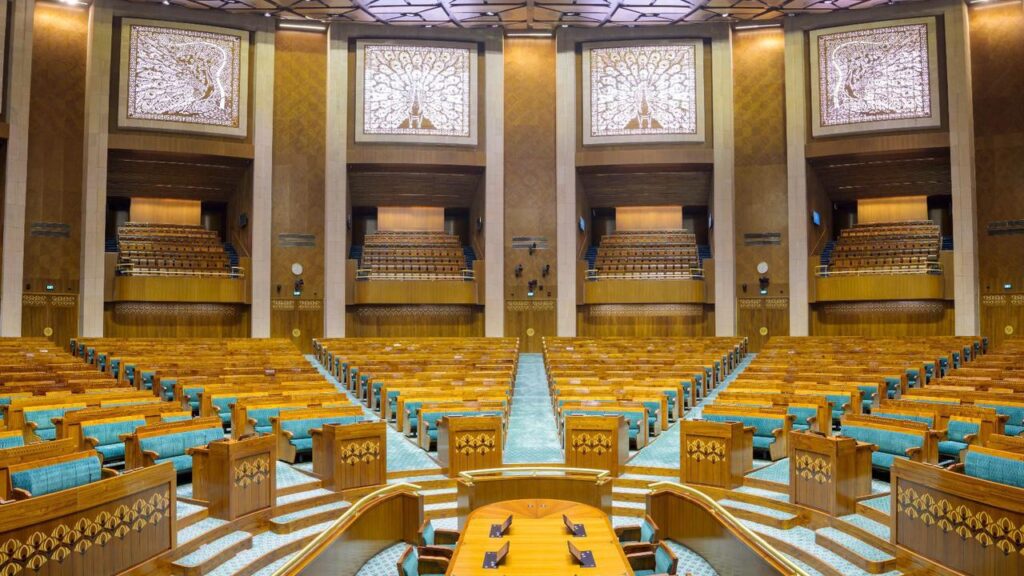
The Constitution does not mention a no-confidence motion directly. Its basis is Article 75(3), under which the council of ministers is collectively responsible to the Lok Sabha. The procedure is in Rule 198 of the Lok Sabha Rules of Procedure and Conduct of Business. The motion can be moved only in the Lok Sabha.
How the motion is moved
A member gives written notice. The Speaker asks the House, and if at least 50 members rise in support, leave is granted. The Speaker then fixes a day for discussion within 10 days of leave being granted.
A vote follows the debate. If the motion passes, the government must resign. A no-confidence motion need not state reasons.
How it differs from a confidence vote
A confidence motion is moved by the government itself to prove its majority. Losing it also brings the government down. In 1999 Atal Bihari Vajpayee’s government lost a confidence vote in the Lok Sabha by one vote.
The first no-confidence motion was moved in 1963 by Acharya J.B. Kripalani against Jawaharlal Nehru’s government. It was defeated.
In a state assembly
In the states the council of ministers is responsible to the assembly under Article 164(2). The Uttar Pradesh assembly’s rules of procedure also provide for a no-confidence motion. Such a motion cannot be moved in the legislative council.
Key points
- The Constitution does not mention a no-confidence motion directly.
- A member gives written notice.
- A confidence motion is moved by the government itself to prove its majority.
- In the states the council of ministers is responsible to the assembly under Article 164(2).
The 2024 Lok Sabha context
In the 2024 Lok Sabha election, Uttar Pradesh’s 80 seats were won as follows: Samajwadi Party 37, BJP 33, Congress 6, RLD 2, Azad Samaj Party (Kanshi Ram) 1 and Apna Dal (S) 1. Lok Sabha and assembly elections turn on different issues and alliances, so the two results should not be added together to reach a conclusion.
The structure of the House
The Uttar Pradesh legislative assembly has 403 seats. Of these, 84 are reserved for Scheduled Castes and 2 for Scheduled Tribes. The majority mark is 202. The state sends 80 members to the Lok Sabha and 31 to the Rajya Sabha. The legislative council is a separate House whose members come through different electorates and nomination.
Official 2022 figures for context
For context, the 2022 assembly election had 15,12,46,168 electors and 9,21,62,897 votes polled, with statewide turnout of 60.94 percent. The BJP won 255 seats on 41.29 percent and the Samajwadi Party 111 seats on 32.06 percent. Apna Dal (S) won 12, the RLD 8, the SBSP and NISHAD Party 6 each, Congress and the Jansatta Dal Loktantrik 2 each, and the BSP 1.
The 2017 baseline
The 2017 assembly election had 14,16,63,646 electors and turnout of 61.22 percent. The BJP won 312 seats on 39.67 percent. The Samajwadi Party won 47, the BSP 19, Apna Dal (S) 9, Congress 7 and the SBSP 4. Three independents also won. Between 2017 and 2022, 125 seats changed parties.
Also read:
- Saharanpur district assembly results 2022
- Ayodhya district assembly results 2022
- Budaun district assembly results 2022
Source: Election Commission of India. Figures are from official statistical reports.
और पढ़ें: आपके लिए चुनी गई ख़बरें → (प्रायोजित)