How the President of India is elected
प्रकाशित
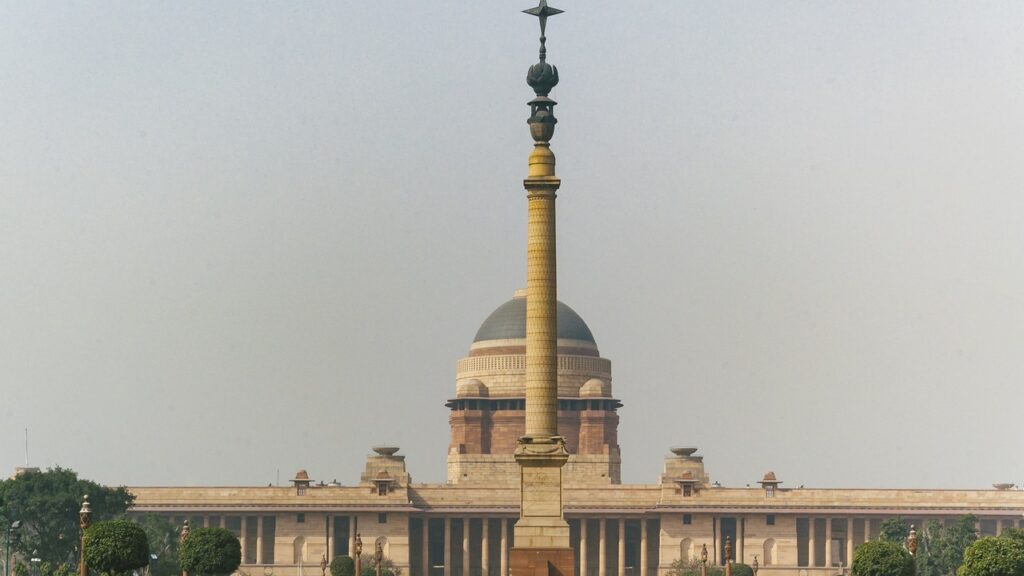
The President of India is not elected directly by voters. Under Article 54 the electoral college consists of the elected members of both Houses of Parliament and the elected members of state legislative assemblies. Since the 70th Amendment, elected members of the Delhi and Puducherry assemblies are also included.
Nominated members and members of legislative councils do not vote in this election. The Election Commission of India conducts it. The term is five years (Article 56), and a candidate must be at least 35 years of age (Article 58).
How the value of a vote is fixed
Article 55 sets out how the value of each vote is calculated. The value of an MLA’s vote is the state’s population divided by the number of elected MLAs, and the result divided by 1,000. The 1971 census is currently used for population.
That is why an Uttar Pradesh MLA’s vote has the highest value in the country. In the 2022 presidential election each UP MLA’s vote was worth 208. The total value of all assembly votes is divided equally among the elected members of Parliament to fix the value of an MP’s vote, which was 700 in 2022.
Voting and counting
The election is held by proportional representation through the single transferable vote, by secret ballot. Electors mark an order of preference against the candidates. To win, a candidate needs the quota, which is more than half the total valid value. If no one reaches it in the first count, the lowest candidate is excluded and those ballots are transferred by next preference.
The anti-defection consequence of a party whip does not apply here, as this is not voting inside a House. Disputes are heard by the Supreme Court under Article 71. Uttar Pradesh’s 403-member assembly is therefore the largest single state block in the presidential electoral college.
Key points
- The President of India is not elected directly by voters.
- Article 55 sets out how the value of each vote is calculated.
- The election is held by proportional representation through the single transferable vote, by secret ballot.
The 2017 baseline
The 2017 assembly election had 14,16,63,646 electors and turnout of 61.22 percent. The BJP won 312 seats on 39.67 percent. The Samajwadi Party won 47, the BSP 19, Apna Dal (S) 9, Congress 7 and the SBSP 4. Three independents also won. Between 2017 and 2022, 125 seats changed parties.
The 2024 Lok Sabha context
In the 2024 Lok Sabha election, Uttar Pradesh’s 80 seats were won as follows: Samajwadi Party 37, BJP 33, Congress 6, RLD 2, Azad Samaj Party (Kanshi Ram) 1 and Apna Dal (S) 1. Lok Sabha and assembly elections turn on different issues and alliances, so the two results should not be added together to reach a conclusion.
The structure of the House
The Uttar Pradesh legislative assembly has 403 seats. Of these, 84 are reserved for Scheduled Castes and 2 for Scheduled Tribes. The majority mark is 202. The state sends 80 members to the Lok Sabha and 31 to the Rajya Sabha. The legislative council is a separate House whose members come through different electorates and nomination.
Also read:
- Budaun district assembly results 2022
- Mathura district assembly results 2022
- Ghazipur district assembly results 2022
Source: Election Commission of India. Figures are from official statistical reports.
और पढ़ें: आपके लिए चुनी गई ख़बरें → (प्रायोजित)