Lok Sabha and Rajya Sabha: how the powers of the two Houses differ
प्रकाशित
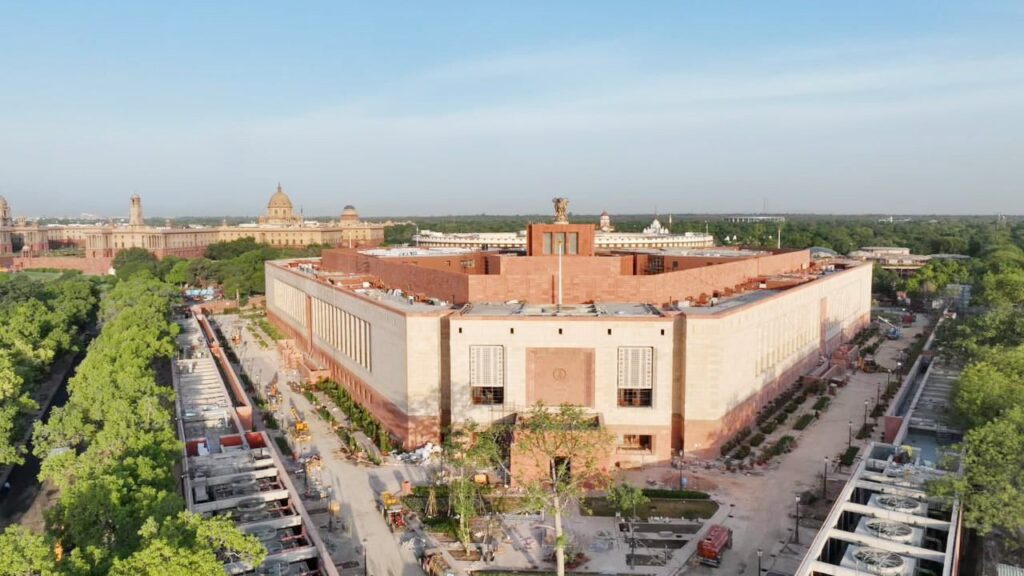
Parliament has two Houses, the Lok Sabha and the Rajya Sabha (Article 79). Lok Sabha members are elected directly by voters, while most Rajya Sabha members are elected by the elected members of state assemblies. Both Houses take part in law-making, but their powers are not equal on every subject.
| Item | Lok Sabha | Rajya Sabha |
|---|---|---|
| Maximum size | 550 elected | 250 (238 elected, 12 nominated) |
| Elected by | Voters directly | Elected members of state assemblies |
| Term | 5 years, can be dissolved | Permanent, one-third retire every two years |
| Seats from UP | 80 | 31 |
Table: UP Election News. Basis: Articles 80, 81 and 83 of the Constitution.
Money bills and the budget
A money bill can be introduced only in the Lok Sabha (Article 109). The Rajya Sabha must return it within 14 days with any recommendations, and the Lok Sabha is not bound to accept them. The Speaker’s certificate on whether a bill is a money bill is final (Article 110).
Only the Lok Sabha votes on demands for grants (Article 113), so it has the final say on the budget.
To whom the government answers
Under Article 75(3) the council of ministers is collectively responsible to the Lok Sabha. A no-confidence motion lies only there. The Rajya Sabha cannot remove the government, but it holds it to account through questions, debates and committees.
If the Houses disagree on an ordinary bill, the President may call a joint sitting (Article 108), presided over by the Speaker. The Lok Sabha’s larger numbers give it the edge there. There is no joint sitting for a constitutional amendment, which must pass each House separately (Article 368).
Powers special to the Rajya Sabha
By a two-thirds resolution, the Rajya Sabha can empower Parliament to legislate on a State List subject in the national interest (Article 249). A resolution to create a new all-India service also comes from the Rajya Sabha (Article 312). The Vice President is the ex officio chairman of the Rajya Sabha.
Key points
- Parliament has two Houses, the Lok Sabha and the Rajya Sabha (Article 79).
- A money bill can be introduced only in the Lok Sabha (Article 109).
- Under Article 75(3) the council of ministers is collectively responsible to the Lok Sabha.
- By a two-thirds resolution, the Rajya Sabha can empower Parliament to legislate on a State List subject in the national interest (Article
The structure of the House
The Uttar Pradesh legislative assembly has 403 seats. Of these, 84 are reserved for Scheduled Castes and 2 for Scheduled Tribes. The majority mark is 202. The state sends 80 members to the Lok Sabha and 31 to the Rajya Sabha. The legislative council is a separate House whose members come through different electorates and nomination.
Official 2022 figures for context
For context, the 2022 assembly election had 15,12,46,168 electors and 9,21,62,897 votes polled, with statewide turnout of 60.94 percent. The BJP won 255 seats on 41.29 percent and the Samajwadi Party 111 seats on 32.06 percent. Apna Dal (S) won 12, the RLD 8, the SBSP and NISHAD Party 6 each, Congress and the Jansatta Dal Loktantrik 2 each, and the BSP 1.
Also read:
- Ghazipur district assembly results 2022
- Uttar Pradesh Lok Sabha 2024 result
- Meerut district assembly results 2022
Source: Election Commission of India. Figures are from official statistical reports.
और पढ़ें: आपके लिए चुनी गई ख़बरें → (प्रायोजित)