
What a money bill is: the main rules under Article 110
प्रकाशित
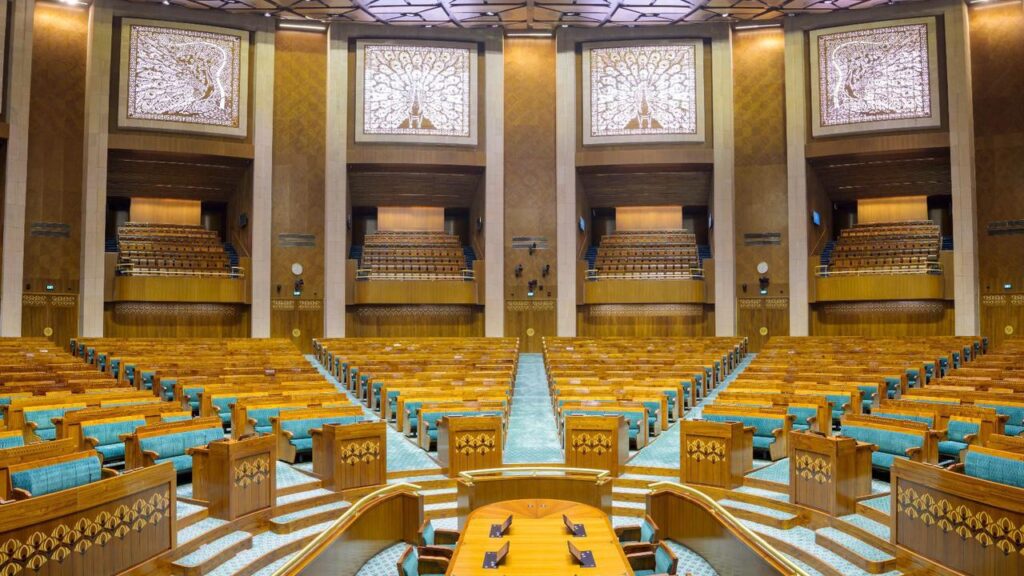
Article 110 of the Constitution defines a money bill. Such a bill must deal only with the matters listed there, such as imposing, abolishing or altering a tax, government borrowing, the custody of and payments into or out of the Consolidated Fund or the Contingency Fund of India, and appropriation from the Consolidated Fund.
A bill does not become a money bill merely because it provides for fines, licence fees or fees for services.
Rules for a money bill
- It can be introduced only in the Lok Sabha (Article 109)
- Its introduction needs the President’s recommendation (Article 117)
- The Rajya Sabha must return it within 14 days, and its recommendations are not binding
- The Speaker’s certificate that it is a money bill is final
- The President cannot return it for reconsideration (Article 111)
How it differs from a financial bill
Not every financial bill is a money bill. Under Article 117 some financial bills contain Article 110 matters along with other provisions. On those the Rajya Sabha has the same powers as on an ordinary bill, though they too must be introduced in the Lok Sabha.
The Finance Bill that comes with the budget is usually certified as a money bill.
The debate in court
The Speaker’s certificate has been argued in court. The Aadhaar Act, 2016, was passed as a money bill, and in the 2018 Puttaswamy judgment the Supreme Court majority upheld that. In Rojer Mathew (2019) the question of how far a money bill certificate can be judicially reviewed was referred to a larger bench.
Key points
- Article 110 of the Constitution defines a money bill.
- __UL__ It can be introduced only in the Lok Sabha (Article 109) Its introduction needs the President’s recommendation (Article 117) The
- Not every financial bill is a money bill.
- The Speaker’s certificate has been argued in court.
The structure of the House
The Uttar Pradesh legislative assembly has 403 seats. Of these, 84 are reserved for Scheduled Castes and 2 for Scheduled Tribes. The majority mark is 202. The state sends 80 members to the Lok Sabha and 31 to the Rajya Sabha. The legislative council is a separate House whose members come through different electorates and nomination.
Official 2022 figures for context
For context, the 2022 assembly election had 15,12,46,168 electors and 9,21,62,897 votes polled, with statewide turnout of 60.94 percent. The BJP won 255 seats on 41.29 percent and the Samajwadi Party 111 seats on 32.06 percent. Apna Dal (S) won 12, the RLD 8, the SBSP and NISHAD Party 6 each, Congress and the Jansatta Dal Loktantrik 2 each, and the BSP 1.
The 2017 baseline
The 2017 assembly election had 14,16,63,646 electors and turnout of 61.22 percent. The BJP won 312 seats on 39.67 percent. The Samajwadi Party won 47, the BSP 19, Apna Dal (S) 9, Congress 7 and the SBSP 4. Three independents also won. Between 2017 and 2022, 125 seats changed parties.
The 2024 Lok Sabha context
In the 2024 Lok Sabha election, Uttar Pradesh’s 80 seats were won as follows: Samajwadi Party 37, BJP 33, Congress 6, RLD 2, Azad Samaj Party (Kanshi Ram) 1 and Apna Dal (S) 1. Lok Sabha and assembly elections turn on different issues and alliances, so the two results should not be added together to reach a conclusion.
Also read:
- Budaun district assembly results 2022
- Mathura district assembly results 2022
- Ghazipur district assembly results 2022
Source: Election Commission of India. Figures are from official statistical reports.
और पढ़ें: आपके लिए चुनी गई ख़बरें → (प्रायोजित)